
Africa was the fastest-growing solar region globally in 2025. That is one of the headline findings from the AFSIA Africa Solar Outlook 2026 report, which tracks installed capacity, cost trends and market growth across the continent.
In this blog post, we unpack key takeaways from the AFSIA report and what they mean for commercial and industrial (C&I) energy users in Southern Africa. While the data is continental, the implications are immediate and practical for businesses in South Africa dealing with above inflation electricity tariffs, grid constraints and ongoing energy security risks.
Africa’s solar growth is accelerating
Globally, solar PV deployment continues to expand at record pace. In 2025 alone, an estimated 618 GW of solar capacity was added worldwide, up sharply from 126 GW just five years earlier. Solar is now firmly established as one of the dominant sources of new power generation capacity globally.

Global annual solar PV additions reached 618 GW in 2025, reflecting the rapid acceleration of renewable energy deployment worldwide. Source: AFSIA Africa Solar Outlook 2026.
Within that global expansion, Africa stands out. According to the AFSIA report, which now incorporates Chinese solar module import data as a proxy to track deployment trends, the continent has recorded a compound annual growth rate of 49% since 2021, outperforming most other global regions, including Asia and Europe.
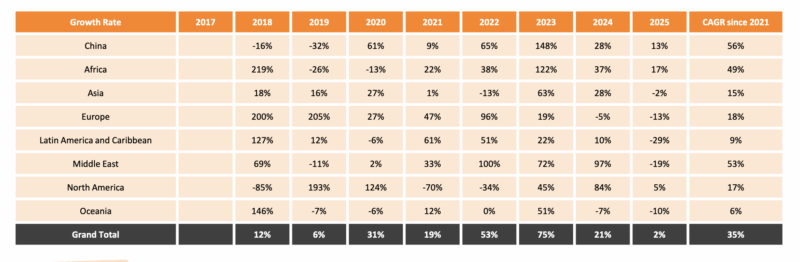
Africa has recorded a 49% CAGR in solar installations since 2021, making it the fastest-growing solar region globally. Source: AFSIA Africa Solar Outlook 2026.
This is not simply growth from a low base. It reflects consistent year-on-year expansion across African markets. Solar is increasingly being procured as primary generation capacity, both at utility scale and by businesses for onsite generation.
For commercial and industrial energy users, this is good news. There are more experienced developers, stronger supply chains and greater price competitiveness than even a few years ago.
Solar-plus-storage economics and the growing role of BESS
One of the clearest insights from the AFSIA data is the improving economics of solar-plus-storage projects across African markets. In several countries, the Levelised Cost of Energy (LCOE) from solar PV combined with a battery energy storage system (BESS) now compares favourably with prevailing grid tariffs as shown in the graph below.

In several African markets, the LCOE of solar PV combined with battery energy storage (BESS) compares favourably with grid tariffs, strengthening the business case for commercial and industrial solar. Source: AFSIA Africa Solar Outlook 2026.
In high-tariff or diesel-reliant markets, the gap is significant. In some cases, grid prices exceed $0.40/kWh, while solar-plus-storage solutions fall in the $0.10 to $0.20/kWh range. Even in more established markets such as South Africa, double-digit tariff increases and demand-related charges are shifting the economics in favour of solar and battery solutions.
For C&I energy users in Southern Africa, the question is no longer whether solar makes business sense. That question has been answered. It is to what extent solar with batteries can displace a meaningful portion of grid or diesel consumption at a lower effective cost over the life of the asset.
As Terra Firma previously explored in our blog on the growing business case for BESS in South Africa, the main drivers that have strengthened the case for storage are falling battery costs and changing tariff structures. The AFSIA data confirms this trend at continental level with the business case for BESS improving across multiple African markets.
This report and our own experience shows that BESS is no longer simply a tool to mitigate load shedding. It is increasingly a financial and operational asset integrated into project design from the outset.
In practical terms, BESS can unlock energy cost savings by:
- Enabling energy arbitrage by charging when solar production is high or grid tariffs are low, and discharging during peak tariff periods.
- Supporting peak demand reduction by capping maximum demand and lowering demand-related charges.
- Enabling time-of-use optimisation by shifting energy consumption into lower-cost tariff windows.
In South Africa, where energy security, the risk of load shedding and tariff volatility remain material concerns, solar-plus-storage is increasingly viewed as essential for long-term energy planning and cost control. It enables businesses to manage exposure to rising tariffs more proactively, rather than reacting to external shocks.
Grid constraints and transmission capacity are reshaping project strategy
Despite record installation rates, the AFSIA report also highlights a structural bottleneck that we’re seeing in many markets globally: grid and transmission constraints are limiting the pace at which new utility-scale solar projects can connect in several African markets.
In South Africa in particular, grid capacity and connection timelines now have a direct impact on when projects can reach financial close and start construction, as highlighted in Grant Berndsen’s recent article on grid connection processes. Securing grid access can add months to development timelines, particularly in constrained regions.
While large utility-scale projects remain critical for long-term system decarbonisation, behind-the-meter solar continues to grow because it can often be deployed without depending on major transmission upgrades.

Installed solar capacity across Africa continues to rise, with decentralised and commercial segments playing an increasingly important role. Source: AFSIA Africa Solar Outlook 2026
Mining and heavy industry are shaping future demand
Energy-intensive sectors such as mining, smelters and large-scale manufacturing are playing a central role in shaping Africa’s future power requirements.
These industries operate continuously and are highly sensitive to both cost volatility and supply instability as is illustrated by the current smelter crisis in South Africa. For industry, energy security directly affects productivity, safety and long-term competitiveness.
The AFSIA data reflects strong growth in large-user segments. In Southern Africa, this is evident in the rise of commercial and industrial solar projects, wheeling and trader off-take arrangements, and hybrid solar-plus-storage solutions designed to provide long-term cost predictability.
For energy intensive businesses, securing stable energy costs over 10 to 20 years can be more valuable than short-term tariff savings. Predictability supports capital planning, reduces exposure to carbon-related risk and improves operational resilience.
What all this means for C&I energy users in Southern Africa
Several clear themes emerge from the report for businesses.
- On-site generation continues to grow. Behind-the-meter solar remains one of the most effective ways to reduce exposure to rising tariffs.
- Solar-plus-storage is quickly becoming the default configuration. Battery energy storage systems are increasingly integrated into C&I solar projects to enable arbitrage, peak demand reduction and tariff optimisation.
- Grid access remains a strategic variable. Transmission and distribution capacity, and regulatory constraints are increasingly affecting project timelines in South Africa, with the latter theme explored in Grant Berndsen’s aforementioned grid connection article.
- Energy strategy is now a competitive differentiator. Businesses that actively manage their energy supply through decentralised generation and storage are better positioned to manage tariff risks, carbon emissions and operational continuity.
At Terra Firma, we see these continental trends reflected in project demand across Southern Africa, especially for behind-the-meter and hybrid solar-plus-storage projects, which are playing a central role in driving new capacity across the region.
If you would like to explore how these trends apply to your operations, or assess the viability of a solar or solar-plus-storage solution for your business, the Terra Firma team can help.

