

In recent years in South Africa, Terra Firma installed battery energy storage systems (BESS) mainly as protection against load shedding. Today, the reason many businesses are investing in batteries has changed.
With electricity tariffs rising and time-of-use pricing creating big cost differences across the day, batteries are increasingly being designed to reduce electricity costs, not just to keep the lights on.
Terra Firma has previously explored this broader change in Battery storage: the new business case for BESS in South Africa. Building on that foundation, this blog post focuses on one of the most financially impactful ways batteries are now being used in practice: energy arbitrage.
What is battery energy arbitrage?
Put simply, battery energy arbitrage allows businesses to avoid buying electricity when it is most expensive. It means charging a BESS when electricity is cheap(er) and using that stored energy later, when prices are higher to realise cost savings.
For businesses, this means a battery can be charged either from on-site solar PV during the day or directly from the grid during off-peak tariff windows. That stored energy is then used during higher-priced periods, reducing reliance on grid electricity at those times. Because of this, arbitrage can work for sites with or without on-site renewable energy.
Arbitrage is only viable where time-of-use (ToU) tariffs are in place and where there is a meaningful difference between tariff periods. Not all South African municipalities have implemented ToU tariffs, and not all tariff structures create a viable arbitrage opportunity. Where businesses remain on flat tariffs, arbitrage is generally not commercially viable, and other battery use cases may be more appropriate.
Selling stored energy back to the grid is currently not a core part of the arbitrage case. Most municipalities do not allow export, and where export is permitted, feed-in tariffs are typically low and inconsistent. In practice, excess energy is usually better used on site by charging the battery and reducing grid consumption during higher-priced periods.
A viable arbitrage case therefore depends on how a facility actually uses electricity, particularly whether it has material consumption during higher-priced tariff periods.
Why arbitrage matters: avoiding expensive electricity
The commercial value of arbitrage comes down to one thing: the cost of electricity during peak periods.
Under South Africa’s time-of-use tariffs, electricity prices vary significantly across the day and especially during the high demand (winter) periods. Peak-period electricity can cost several times more than off-peak power.
In large metros such as Ekurhuleni, peak electricity prices during high-demand seasons can exceed R11 per kilowatt-hour, while off-peak rates may be closer to R1.50–R2.00 per kilowatt-hour. This price gap underpins the arbitrage business case.
For many commercial and industrial businesses, shifting their operations into cheaper periods is simply not practical. Production schedules, refrigeration loads, trading hours and operational constraints mean that a large share of electricity consumption often falls into the most expensive hours of the day.
As tariffs have increased year on year and above inflation, exposure to peak pricing has become increasingly expensive, cutting directly into operating margins and profitability.
Without batteries, businesses remain fully exposed to peak pricing and have limited control over when they draw power from the grid.
How much can businesses save?
Where peak-period demand is consistent, and the battery is correctly sized and actively managed, arbitrage can reduce a business’s electricity costs by around 10-30%, and in some cases more. Actual savings and commercial battery storage benefits depend on the tariff structure, the site’s load profile, seasonal variation and how well the system is operated over time.
Based on Terra Firma’s experience, arbitrage-led battery projects typically achieve payback periods in the range of three to five years, particularly where systems are designed specifically for arbitrage rather than adapted from backup-only installations. These savings translate into attractive IRRs for BESS installations in South Africa.
It is important to note that arbitrage is not automatic. Savings do not materialise simply because a battery has been installed. Performance depends on how the system is designed, controlled and operated.
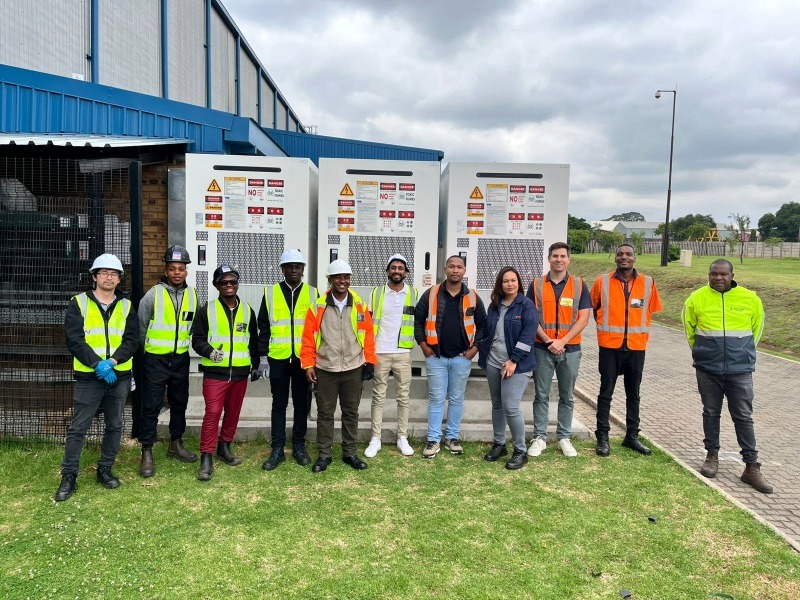
Huawei battery systems recently installed at Fortress REIT sites that are operated by global logistics giants
What makes arbitrage work in practice
From on-the-ground experience, a small number of factors consistently determine whether arbitrage delivers value.
- Tariffs come first. Arbitrage depends not only on having a time-of-use tariff, but on the size and consistency of the price difference between peak and off-peak periods. Tariff changes over time also matter, as arbitrage strategies may need to be adjusted.
- The site’s load profile is equally important. Arbitrage works best where peak demand is both material and predictable. Sites with limited or irregular peak-period consumption will struggle to extract meaningful value, regardless of battery size.
- Correct system sizing is critical. Batteries need to be sized appropriately in both power and energy terms relative to actual demand. Over-sizing dilutes returns, while under-sizing limits achievable savings.
- Accurate data and metering are also essential. Arbitrage relies on reliable interval data and correct tariff mapping. Poor data quickly undermines optimisation.
- Finally, arbitrage needs to be considered alongside other battery use cases. Many systems are still expected to provide backup or resilience. These requirements can conflict with arbitrage unless the operating approach is clearly defined from the outset.
How Terra Firma approaches arbitrage
One of the clearest lessons from early battery deployments in South Africa is that arbitrage is not set-and-forget.
Terra Firma designs arbitrage-led battery systems with a clear operating philosophy from the start. This means aligning with clients on what the battery is primarily intended to do and how different objectives, such as backup and cost reduction, are prioritised.
Savings projections are based on live site data and actual tariffs, using conservative assumptions around efficiency, degradation and availability. Once systems are operational, performance is actively monitored and adjusted to reflect changes in tariffs, seasons and site operations. Long-term maintenance and operational updates are treated as essential to protecting value, and the Return-on-Investment over the life of the system.
Common pitfalls to avoid
We often see several issues in the market:
- Treating arbitrage as a set-and-forget function is one of the most common. Without active optimisation, value can erode quietly over time.
- Poor sizing is another frequent problem, particularly where batteries were originally designed for backup and later expected to deliver arbitrage savings they were not sized for.
- Ignoring tariff or operational changes can also undermine performance. Arbitrage strategies need to evolve as conditions change.
- Over-promising savings or export revenue remains a risk, particularly given the limitations of feed-in tariffs.
- Operating batteries outside the regime they were designed for often dilutes returns and shortens asset life.
Modelled arbitrage results
Terra Firma has delivered over 16 battery energy storage systems in SA’s commercial and industrial sector to date, totalling approximately 26 MWh of installed capacity, with a further 20 MWh in the current order book. Around 75% of these projects include solar PV, while the remainder are standalone battery systems.
While many of these systems were initially designed for backup, most are now operated with arbitrage playing a central role in how they deliver value. This reflects a broader change in how batteries are being used as tariff structures and operating conditions evolve.
In the table below, we show modelled results for different sized arbitrage systems under different tariff regimes. Notice the difference in winter and summer savings achieved.
Modelled savings and ROIs
| Case study | Municipality/ tariff | System size | Winter/ High Demand Saving | Summer / Low Demand Saving | Total annual saving | Est. payback period | ROI |
|---|---|---|---|---|---|---|---|
| 1 | Eskom Miniflex | 1.5 MWh | 34% | 13% | 20% | 4.5 years | 21% |
| 2 | Eskom Miniflex | 900 kWh | 29% | 19% | 22% | 4 years | 23% |
| 3 | Ekhurhuleni E | 500 kWh | 46% | 21% | 31% | 3 years | 31% |
| 4 | Ekhurhuleni D3 | 10 MWh | 22% | 4% | 11% | 4 years | 23% |
The bottom line
As time-of-use tariffs become more widespread and electricity prices continue to rise, arbitrage is increasingly becoming the main driver behind new battery projects. If executed and managed properly, arbitrage allows businesses to avoid expensive electricity, manage peak exposure and reduce operating costs. But it requires clear intent, careful design and active operational management.

